
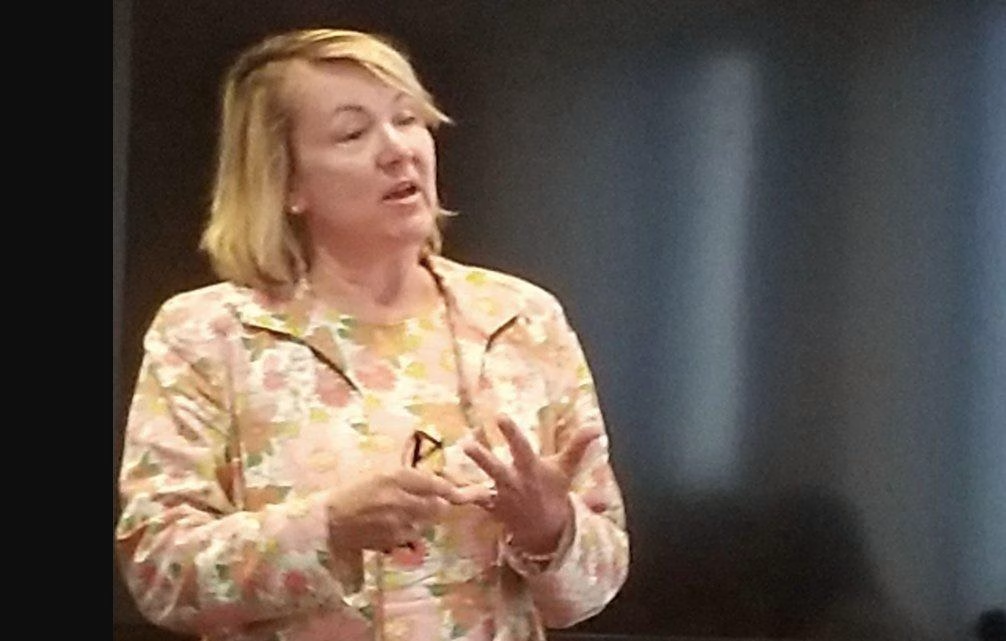
MusiCares' Human Services team provides financial assistance and resources to the music community year-round. There have been many providers that have generously offered their services and expertise to MusiCares' clients at our financial wellness themed programs.
One of those providers is Certified Financial Planner™ Anthea Perkinson. She founded Monterey Associates, an independent, advice-only, fee-only service investment advisor firm registered in New York State.
Anthea also developed the curriculum for the Money Made Simple course, a philanthropic initiative that offers free training in personal money management. She works with MusiCares on its Advisory Committee as one of the organization's financial wellness experts.
As a part of our new "Provider Spotlight" series, MusiCares is thrilled to highlight Anthea Perkinson in honor of Financial Literacy Month and in gratitude for her gracious service.
How did you become immersed in the world of financial wellness?
I was a career changer into financial planning. My entire career has been in finance, but I was working for a large international insurance company until the end of 2012 when I decided that I wanted to effectively become my clients.
I used to call on banks, and the bank investment rep sold our products, and I used to train them as a part of what I did. I went to a top producer meeting for women advisors out in California. I was struck at how passionate they were about serving their clients and how they all talked about what wonderful work-life balance they had. Most of them were independent financial planners or investment advisors, and they took time off when they needed to be with their family.
I was there for the weekend, knowing that I would have to go back to a suitcase change and be in Chicago for the rest of that week, and I was like, "What am I doing? That sounds so much better."
I pursued the Certified Financial Planner designation. I knew I had years of experience and a lot of the topic matter was very, very familiar. I studied for that and passed the exam in July of 2012.
When I passed, I joined the Financial Planning Association to actually meet other planners and to do a lot of pro bono work. I really wanted to find out how comfortable I was going to be talking to people about their money. I really hadn't done that before.
I taught personal financial management in community colleges, social service agencies, and nonprofits in the library. I did coaching sessions and one-on-one planning sessions with people, and I really loved it. I still do a lot of volunteer work in all of those places, because I just enjoy it so much — and from it, I learned how to become a better teacher.
One of the things that I discovered over the course of the 10 years is that you can't just walk in and teach a class on a personal finance topic, like investing or credit repair, when the group has every different level of understanding personal finance — and lots of different financial situations are in the room. You have to make it very relatable.
So what I tried to focus on, regardless of what topic I was teaching, is how can I make people feel more effective in managing their personal finances? Give them a sense of control. So whether I'm teaching budgeting, credit, dealing with debt, managing a credit report, or improving your credit score, how do I make each and every person in the room feel like "Oh, that's a great idea."
I can do that, because having that sense of control is what it's all about. That is financial wellness — that you are not knocked back on your heels when a financial matter comes up. That is what I aspire to do: make the whole topic of personal finance less anxiety-provoking, because that's debilitating. If you're anxious about money, that's really tough.
Why is financial wellness important to you, and why should it be important to others?
As somebody who has interviewed, at this point, probably thousands of people about their financial practices, situations, concerns and goals, you realize that when people do not feel that they are in control of their personal finances, they do not feel a sense of wellness about this, and it inspires anxiety. It causes people to freeze, and it is challenging in relationships when money becomes a source of stress and strain.
On the reverse side of things, once you feel wellness — once you feel what it's like to not have to worry about money, or even if you're not making a lot of money — you have systems in place that you're doing the best you can with what you're making. You don't have to stress about it. You don't wake up thinking about it, and that is incredibly freeing.
What are some of the biggest barriers that stand between individuals and financial literacy?
One of the biggest, honestly, is that for most people, it's not interesting. It's not interesting to sit down and read about how credit cards work, what's on a credit report, what's the most effective way to pay down credit, credit card debt, or deal with your student loans. Most people would rather do anything than study this.
A lot of people point to the fact that this is not taught in schools. But I've taught personal finance in high schools and community colleges, and the same phenomenon exists: If there's not a native interest, it doesn't get very far. The challenge to do it well, and to do it effectively, is sort of a just-in-time delivery of education. So having a workshop where you say, "We're going to talk about getting out of credit card debt," only the people who have credit card debt and are motivated to try to do something about it are the ones who attend, and those people get something out of it. Whereas if you taught this in high school or college class, and it has no relevance to their day-to-day, there's not a lot of uptake.
You see this also in another area: how mortgages work, and what the whole process of buying a house using any kind of mortgage is. Nobody knows how that works until they do it. Once they're in the process, they're very motivated to learn all about it, and they are generally easy to coach, because they have a great deal of interest in getting it right. That's a serious financial commitment.
That kind of shows you how important it is to be personally motivated — because otherwise, nobody's reading about this or wants to hear about it.
How have you worked to break down these barriers in your career?
I've done a couple of things. I do think I've become a better teacher over time, and part of it is being able to talk to very broad audiences. It is easiest if you don't have people who range from very, very little income to a lot of income, no investments to lots of investments, as those people are there for very different reasons. Talking to these different groups, you can make this highly relevant and impactful. The simpler you can explain complex topics so that people feel like you're not talking over their heads or talking down to them is critically important.
The other factor is trying to teach strategies and techniques that are actionable. I refer to a lot of phone apps and great websites, places where people can, on their own, look this stuff up. Do calculations, do projections, shop effectively for different types of financial products and not feel like they don't know what they're doing. That's helpful to me.
Apps, in a world of FinTech, with all these great apps for either saving or investing, that's really fun. Part of it is because a lot of these apps bring gaming techniques into it. So there's these little reward factors that happen, and that's now motivating. When you can align these tools with helping people achieve their financial goals — because they're saving more, they're investing more, they're watching their own progress — it reinforces and motivates people. That's really effective, empowering and rewarding as a teacher.
How does Monterey Associates make financial planning simple for anyone, regardless of their experience level?
Part of it is process. People engage with me to figure out if they need a financial plan, have a particular financial problem, or have a goal that they need to get organized around. I interview these people to find out what their financial situation is, what their financial goals are, what their concerns are, etc.
Looking at the things that they view as problems, how can I help them? Not everybody needs a full-blown financial plan. Many, many people need what I call financial organization. I'll talk to somebody, and they're anxious that they don't feel like they're saving enough for retirement. They realized they've not thought about it, and it's gonna happen someday.
Helping people understand their current situation and what levers to move to be able to save more toward retirement — or to come up with a down payment on a house, buy a new car, or educate their children, etc — it's kind of game-like, teaching people how to organize and frame the problem, or the goal, correctly, and how to organize your money to support that goal.
Whether that is better methods for saving money, automating things, I'm big on automation. If the goal is as big as buying a house for the first time, we've got to worry about not just the down payment, but what's the credit score look like? What are the debts you have?
Preparing people for that whole process is, for me, fun. For them, I try to make it less stressful. Most are really anxious when they're buying their first home. Interviewing people, finding out where they are, and meeting them there to help them understand what generally moderate, modest changes they would need to make to be able to save more, invest more, and achieve near-term and long-term goals.
What are some common misconceptions about financial planning you'd like to debunk?
Most people have never written down their budget. And I'm not somebody who says, "You gotta keep a budget. You gotta enter those numbers every month, and you gotta measure—" No. No, no. You should do it once in a while. Write it all down, and see where the money goes. It's a snapshot. Are you happy with that? What would you change? Are you motivated to change your spending habits? What would you use that money for that's more important to you?
That is the key: the motivation. Not writing it all down, at least once in a while, to see where it's all going is the reason why most people are walking around somewhat anxious about their financial situation — because it's a little wooly. They don't really know exactly how it all works. They just know that there's either money in the checking account at the end of the month or there isn't. That's one thing I see that people don't do that can be a problem.
[Another] is they will have debt on multiple different credit cards, sometimes also some personal loans, and all the interest rates are all over the map. There's no thought to using your lowest interest rate card. That's if you're going to carry a balance — that's where that balance should be until you can pay it off.
I meet with people over and over again where the most expensive interest rate card is where the big balance is. Sometimes that's because there are these rewards of some sort, [like airline] miles or dollars back. If you thought about how much it's costing you to get those rewards, it's not a good deal.
The other problem is that people tend to put off saving for retirement, meaning that they might sign up for their 401k plan, but they come in at the lowest possible contribution amount. They're putting in the lowest amount for too many years, before I come along and say "Hey, you need to up your game here. I know you're only looking to make the match, but you need to build a tank now."
The way compounding works is, the bigger the base you have compounding earlier on, the bigger the account balance you potentially have at the time of retirement. So it's best to start early and be thoughtful about it.
How did you first hear about MusiCares? How do you see your financial wellness expertise and MusiCares' mission aligning?
I was invited by a colleague to co-present to MusiCares years ago. We came in and we did a basic budgeting class together, and that was my first introduction. It was really fun, and these artists were very different from a lot of the people that I had worked with, as both a personal finance instructor but also as a planner.
It was really interesting to hear the way they manage their money. [These are] people whose income is so variable, that putting together a budget just seems like a really impossible puzzle. There are ways to do it, and we talked about how to do that.
What also struck me is that they were all really optimistic and very interesting to talk to. Even though some of them had tax problems and debt problems, they were optimistic, and that's really fun — to work with people who have a bright outlook. They are easier to teach.
After doing that, I came back and I did a program for women through MusiCares. It was held at the Actors Fund location, and I did it as sort of a "What are the top five things you need to know about personal finance?" [seminar] just to boil it down for everyone. If you can master this, you can control your money and feel much more empowered.
After that, I did an investment program. I really liked talking about investing, and it was an opportunity to also talk about retirement accounts and making sure that people know where to invest. You can open up an IRA and invest for retirement, or you can open up a mutual fund account directly, or a brokerage account, etc. We took a look at the advantages of all of these options. It was just a lot of fun!
Can you share any stories from your experience benefitting the MusiCares community? Do you feel like you have strongly impacted any of our clients?
Yes, I did work with two people that I felt that I helped quite a bit.
One of them, early on, had kind of a tax mess going on. She had not filed in years, just because she didn't know how to do it. I was able to introduce this woman to a CPA, who happened to love doing back-taxes and had been an IRS auditor, so somebody would review taxes in audit. He knew where all the lines were. Having him help people get current with back-taxes was terrific. This relieved a whole stress bomb for this individual.
The other person I helped had a lot of credit card debt and variable income. This would sort of build up, as there was no money coming in. We created a system of a budget that was based on percentage of earnings. So, if you know you have $5,000 coming in this month, what do you need to pay your basic bills? How much can you put aside for taxes, and what percentage can you apply to debt reduction? That became an effective way for this individual to navigate her way out of debt and not to get too deeply in debt going forward.
How can music industry professionals and musicians specifically benefit from financial planning?
Well, as I mentioned before, a lot of musicians in particular have very short periods of great income and periods or virtually no income. Being able to sustain your regular lifestyle — whether you're making money or you're not — is all about planning. Saving in advance, and planning your spending, so that you don't run out of money during those periods when you're not working.
There are definitely techniques for doing that, and practice makes perfect. There's also an effective way to use debt. To have a low cost, low interest credit card to help you through those periods before you're waiting to get paid, that can be an effective strategy as well.
The other thing that musicians in particular have to be worried about [is], you're self employed for the most part. You're a 1099 person. That means it's on you to fund your own retirement, and to make sure you stay straight with the tax man.
It makes sense if you do quarterly estimated taxes. Hopefully you're working with a tax preparer who will guide in that regard, but don't ignore that. Don't be tempted to take every possible business deduction to pay no tax, because if you pay no tax as a self-employed person, you get no credit for any earnings through the Social Security Administration.
You may find when you get ready to retire, that you don't have a great payment or claim to be coming to you. So, that's a precaution for every self-employed person. For people who have this variability in their income, that's a serious concern. We want to make sure that you are paying some self-employment taxes just a bit. Then, when you're ready to retire, you can count on a check.
Are there any last points of advice or information on financial wellness that you'd like to share with the music community?
I'm working right now with many, many, many clients — pro bono and regular pay clients — on student loans. There is this public service loan forgiveness waiver right now that's in place until October. I don't know the extent to which any musicians work for nonprofit organizations, but if they do, meaning that the organization is a 501(c)(3) like MusiCares, if you have student loans you should apply. See if you can have your loan balance forgiven.
The waiver is more or less a recognition that this program has been squirrely since the beginning. Many people who thought that they were dutifully making their 120 payments on an income based repayment plan while working at a nonprofit, technically weren't in the program. They forgot to toggle a switch, or they had a loan that didn't qualify, and they've been naively going along and then they get bounced and told, "Nope, sorry, doesn't count." '
They're literally reviewing all of these cases. There's a special form you send in, and they will go back and look at all of the payments made to tally them up. I had one client relieved of $40,000 in student loan debt. It's in place only until the end of October, so people should look into it.
There is something else that I wish people knew. There are an awful lot of people out there who think that if they leave a job where they were contributing to a retirement savings account, that that money is gone forever. There was another person with MusiCares that I told, "This money is yours, you contributed it. You can collect it and roll it into an IRA." And there were people who said, "Holy smokes, look at this!" So, they rounded it up to create these retirement accounts for themselves.
Also, the website missingmoney.com, that's like a parlor trick. I always tell people about this when I do presentations. You go in and you put your name and your state, and you hit enter. It's connected to all of the state controllers, and it's literally money that's been left behind.
You should search your own name and all the states you've lived in, and for friends and family. You will find things like refunds from utility companies that were never claimed because you moved and you didn't leave a forwarding address. Or even life insurance claims, and you're the beneficiary of your rich uncle's policy. That's where it ends up if they don't know how to get a hold of you. I have found significant amounts of money for people and I've found smaller amounts for others, so it's always worth looking.