
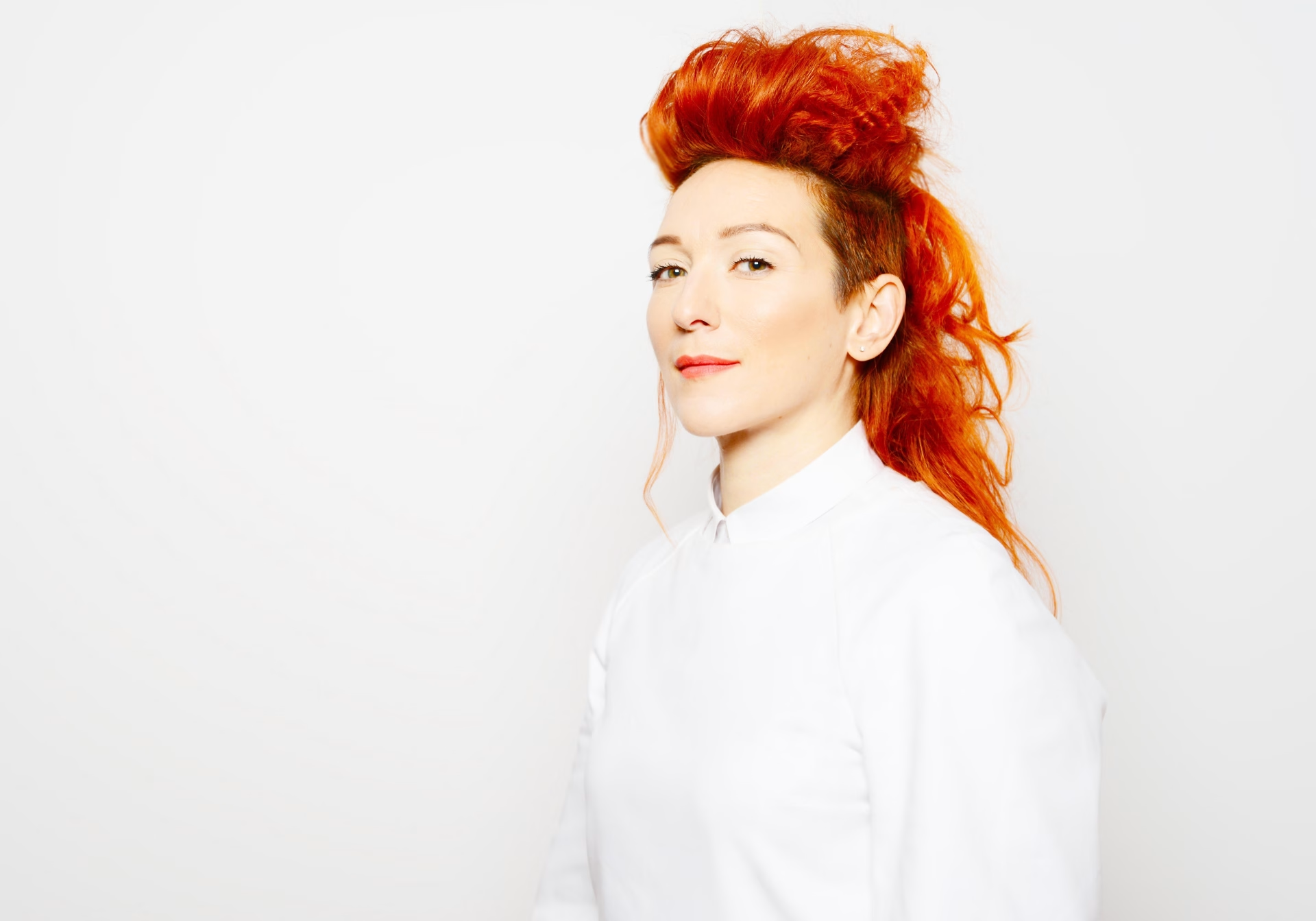
As a champion for women in music, MusiCares celebrates their power and progress made toward equality. MusiCares hopes to encourage women to choose a career in music by making the industry a safer place for women through tailored programs, support groups, and specialized care from our expert staff.
One of MusiCares' clients, artist and composer Shara Nova, received full-spectrum care from MusiCares, which helped her to continue thriving as a trailblazing woman in music. Nova has released five albums under the moniker My Brightest Diamond, and often composes music for unusual spaces for orchestras and choirs. In the fall of 2022, Nova co-composed "The Blue Hour" for the string orchestra A Far Cry alongside four other composers, Rachel Grimes, Angélica Negrón, Caroline Shaw, and Sarah Kirkland Snider. Her most recent composition was for GRAMMY-winning choir the Crossing.
Along with her composition work, Nova has been a sought-after guest vocalist for Sufjan Stevens, Bryce and Aaron Dessner, Son Lux, David Lang, David Byrne, Laurie Anderson, Bon Iver, The Decemberists, and The Blind Boys of Alabama, among others.
As Women's History Month comes to a close, Nova shares her experience as a woman in music and encouragement for the next generation.
How long have you been a professional songwriter, singer, instrumentalist, composer, orchestrator, and performer? At what young age did your passion for music begin, and how?
My paternal grandfather was a traveling evangelist who played guitar, and the family sang and all played, living itinerantly throughout the country for over 50 years. My dad continued in that tradition leading church choirs. My mother's family is all musical too, so I would say there was never a time that music was not my life. It is part of the way love is communicated in the family.
Even still, when I was 18, no one knew that women could be composers, so I studied operatic voice. In college, dad gave me a guitar he bought at a garage sale and I learned to play and started writing then. Only later in life I began to realize I could actually call myself a composer. \
\
Your work exudes confidence, intention, and purpose. As a woman in music, was there a moment you decided on that confidence, and what did you overcome to get there?
The journey of carving your own path is both exhilarating and also can be very agonizing. I always tell younger people that no one can hand you the dream you have envisioned. While we acknowledge the trailblazers who came before us, and through their struggles made it possible for us to be where we are now, we simultaneously must pave our own unique road. Thank goodness there are more women in classical music now than there were when I started, but of course we have further to go.
I am confident because I fight every day to be confident. And it is a fight. I have amassed a great many skills through study and discipline. I trust a rigorous process.
That said, I'm very aware that I didn't get to where I am on my own. Even still, I often feel the impacts of the patriarchy, the desire of people to create a male genius and be saved by one, and that reality hits not just in a very emotionally painful way, but also in opportunity.
I've also time and again seen the contributions of women remain unmentioned and our capacity continually doubted. However, I also have been blessed with incredible collaborators, who are cis men, who have supported my work in countless ways. That I am surrounded by primarily cis men, incredible as they are, is perhaps still very telling of where we are as a culture. \
\
What is the link between your womanhood and your artistry?
In university I internalized that singers were very often thought to be stupid musicians. Add being a "girl" to that Venn diagram. It was very clear to me at 18 years old that I had a lot to prove to people. I pushed song form. I pushed arranging. I downplayed my sexuality.
After more than 25 years of a professional life, I'm finally starting to say to myself, "Hey Shara, you've done a lot. Made pop records. Wrote some operas. Made some films. Wrote a lot of choral music. Maybe now it would be okay if you wrote a song for yourself with three chords."
But those songs couldn't even come out of me before, because I have been fighting just to be taken for my mind and my creativity and for who I was. People are often still wanting a Mother or a Maiden, and I haven't wanted to be either of those archetypes. I do engage with my masculine and feminine sides fluidly, but presenting as I do has meant being a warrior and fighting for one's own right to exist, and thus the right for everyone to have space to exist.
Through your music, it seems as though one of your missions is to channel the beautiful complexity of human nature. Can you speak about how having strong mental and emotional health helps you serve as that channel?
I have really good friends. I have really loving musical collaborators. It's important to work with nice people.
These years have been extremely stressful. I have been in survival mode more in the last three years than ever before and I do not know if I am even now balanced or healthy.
It's hard to take care of yourself while you are continually running. I feel like I'm trying to produce work in the midst of a storm. My friends and those texts and phone calls are lifelines of sanity.
Of course, our spiritual life reveals itself and one's character is tested in these times. I have fear like everyone. I think revealing that honestly and making work about that, to reveal a process (not an arrival) of what it is to engage with the fear, or conflict, or contradiction, has become part of the artmaking itself. May we all have more courage in these times.
When and how did you first hear about MusiCares? And how has MusiCares helped you?
I have been a GRAMMY member for a long time!
How we as musicians engage with issues and care for people, but don't take on the stress into our bodies, is a challenge indeed. In early January 2020, I was experiencing a lot of stress with physical symptoms and reached out to MusiCares. I began experiencing gut health issues, and then got COVID in May of 2020. The long-term effects of COVID on my body continued for two years, and I was bedridden and unable to work for days on end.
When I say MusiCares helped me, it more than helped me. Having support to pay those medical bills and relieve financial crisis (which was part of the cause of the illness) allowed me to focus on a healing journey and get me out of that financial hole faster, and back to making music. These resources have truly been a lifeline, and I will keep saying thank you.
Who are some of your most influential women in music?
I live in Detroit and I am always paying attention to poet jessica Care moore, beautiful harpist Ahya Simone, songwriter and incredible creator Tunde Olaniran, tingle to the bones singer Kisma Jordan, and saxophonist wunderkind Kaleigh Wilder.
In Detroit, we are still building this musical ecosystem so we can keep people around longer! A lot of folks head to the coasts, but my favorite up-and-coming [artists] are Alex Koi of Saajtak — who is doing amazing in NY now, working with the revolution that is Toshi Reagon — and brilliant composer Tanner Porter is taking on New York now too. \
\
What is your message to young women and female-identifying folks starting out in today's music industry and creative landscape?
Get your tech. Take a lesson if you can't stand watching YouTube tutorials. Perform at open mics. Apprentice. Practice. Make a schedule and honor your art making time as valuable. Get out of your house and put yourself in the environment you want to be in, even if that means just going to shows.
Get to know people. Working in music can be like working in a restaurant. It's easier to pick up shifts if you are in the kitchen than to make someone have to pick up the phone to call you.
Be in the room. You must understand the computer stuff in order not to be beholden to other engineers controlling your work. Always keep a copy of your sessions in your possession. Power comes from knowledge and having more accurate use of language.
Do not give up. Have wild belief in yourself. Have wild belief in those around you. Believe in other women.
In my experience, in order to have the rigor needed, we are always making hard choices. But if you figure out how to "have it all," please DM me!