
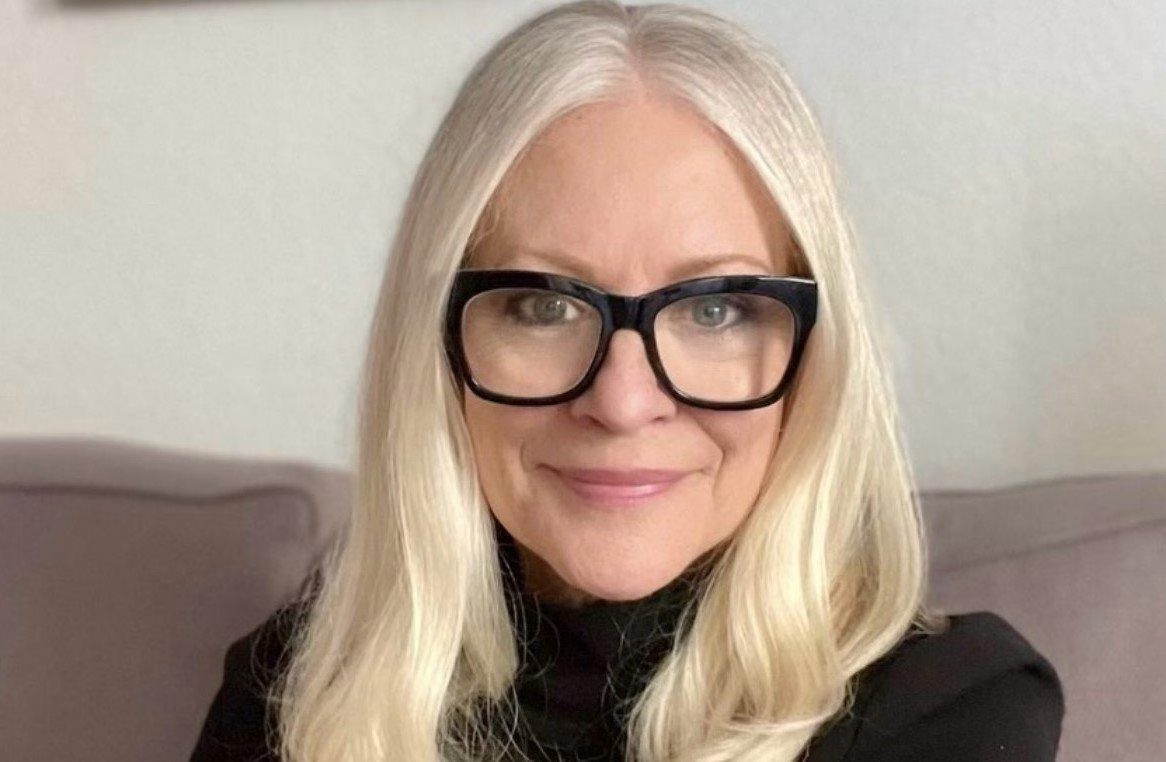
Throughout the year, MusiCares partners with medical providers of all kinds to bring health services to music people nationwide. These providers often generously offer their services to MusiCares at a reduced rate, out of kindness, allowing MusiCares to serve even more music people in need.
One of those providers is Lyn Rowbotham, Phd, LMFT, of Therapy Solutions in Malibu, Calif. She works with MusiCares to provide therapy focusing on mental health and addiction recovery to the music community in need.
As a part of our "Provider Spotlight" series, MusiCares highlights one of our incredible providers with an interview that dives deeper into their work, their story, and their introduction to MusiCares. In honor of National Recovery Month this September, MusiCares is honored to highlight Lyn Rowbotham and her dedicated service to the recovering music community.
How did you first become interested in the topic of mental health and becoming a therapist?
I first became interested decades ago, long before I ever started studying it. I'm fascinated with psychology, and I think I started with a fascination for art therapy when I was studying art myself. I was involved with helping a children's charity with art therapy, and that kind of inspired me to go into studying psychology and getting my master's degree.
I worked with children and families first. Addiction recovery wasn't my aim, but that showed up immediately working with children and families. I went on to get my PhD in psychology and it's not only my passion, but I feel like it's a calling. Serving others, being of service, and being able to help if and when I can, is really important. I try to come from that place all the time and ground myself in that.
I started by getting a job as a primary therapist maybe 11 or 12 years ago, and that's when I first had my first MusiCares client. I was working at a private residential treatment rehab and a client came in that was a MusiCares referral. I was just assigned to that client randomly, and that's how I first heard about it. I found it to be challenging and inspiring at the same time, and it hasn't stopped since.
What would you say to people who don't understand addiction to be a legitimate mental health issue?
To me, this is so important. Addiction is a treatable medical condition. It is not a moral failing. I say this all the time, because usually by the time somebody seeks help, there's been a fallout in their lives. There's just been so much trauma, shame, broken relationships, mental health struggles, you name it. A lot of people's families or friends see it as these people making a conscious choice, and it's a moral failing. I think that definitely exaggerates a lot of mental health issues and can create a lot of other problems.
So, I'm really big on saying it is not a moral failing. A huge portion of people that lean towards substance abuse are also experiencing co-occurring mental health issues. They're trying to cope with something, or self medicate, or they're trying to find a way to deal with whatever else is going on. Mental health and addiction really often go hand-in-hand.
Read More: 5 Ways MusiCares Supports Mental Health And Wellness Year-Round
What is your strategy on approaching the feelings of shame and guilt that can often come with addiction?
I meet every client exactly where they are. I try to jump in with whatever is going on in their life — no matter how chaotic it is. I try to start there. I don't use a cookie-cutter approach. It's really tailored to whatever that person may need, or what they're experiencing. I look at all parts of their lives and the system that they're a part of, whether that be a band, a family, a relationship, or all of the above. I try to not only support the client and educate them on how this works and why, so they have a deeper understanding of what's going on with them — but also educate others in their lives about addiction and how to manage it from that place.
I always think it's important for any therapist to go in with a lot of compassion and a lot of understanding. But also, with that being said, really honest communication and open communication. You want to foster a connection with a client where they can trust you, and they know that you've got their best interests at heart. They should know that you're there to support them and not to judge.
I think an important message is that there's always hope. Always. It's never a lost cause, ever, no matter where you are in your life and what you're struggling with. I truly believe it's just never too late. There's always hope.
Can you speak more on the effects of addiction on mental health — both when it comes to the individual, as well as their family and friends? How are peers affected?
Let's say you have somebody that is experiencing addictive behaviors. These behaviors and situations that clients are in, alongside struggles that they have, can also be triggering for other friends and family. Oftentimes it puts a light on their own fears. The client's peers may start to question to themselves, "Am I an addict in some ways?" It kind of calls into play everyone's behavior, in a certain way. It can trigger a lot of feelings of their own issues. It's sort of like a domino effect. Somebody that's struggling with their own mental health issues and addiction issues definitely has an influence on others.
A lot of times I've seen that it has a positive influence on others. It might get messy at first, but it could ultimately have a positive effect. When one person makes the decision to go on the journey to get healthier, it might ripple out into their world and shake things up, encouraging their peers to do the same. It's not in a bubble. I don't think anyone that I've ever worked with has operated in a bubble. There's a whole world around them.
I try to help guide [the] family as well, not just the client. I figure that working with family and everyone within their close circle is also helping them. I do have a really strong belief that it isn't just about the hour or so in a session that I connect with a client. All of my clients have my cell phone number, and I encourage everyone to reach out if they're really struggling with something or they feel overwhelmed. It can be really helpful for clients to know that they can check in — it's not just the scheduled time. My belief is that when you can bring it into real time, real life situations, it's more effective.
Do you have any advice you can share with people wanting to get help for a family member or friend who may be resistant to getting help for themselves? How would someone go about approaching that in a sensitive way?
Just communicating from where you stand is important. Let's say I'm a family member, and I have somebody that I'm really worried about, I'm scared for their safety, and I see behavior that worries me. The first place to start is to try to have an honest discussion and let them know that you're concerned and what you're feeling. No blame, no shame, no accusations, no ultimatums. Just speak from the heart of why you're concerned, and that you're there to be of help and to support them. That's the place to start.
Read More: How MusiCares Supports Holistic Health & Wellness In The Music Community Year-Round
For people in recovery, how can they continue to prioritize their mental health and lower the risk of relapse?
It's important to remember that addiction can affect the part of the brain that responds to the reward system, stress and self control. There's a lot of impulsivity and there's a lot of stress management. There's a lot of life skills.
After somebody has been able to put the substances aside and experience a decent amount of sobriety time, then it's time to work on the emotional sobriety. This is what supports all of it, and it's really getting down to those underlying co-occurring things that maybe fueled it in the first place.
Addiction is a symptom, in a lot of ways, of other things that haven't been able to be managed or dealt with. Giving them the skills, the techniques, and the empowerment to learn how to deal with all of that stuff is so important, because life doesn't just stop and stress doesn't just disappear. Giving them the tools they need and the support to carry that on is key.
How can members of the music community working on tour and on the road find consistency?
The road can be so triggering. Imagine playing at a bar as a musician in recovery and in sobriety. All of it is very triggering. One of the most effective ways to deal with touring is to be proactive. You can set up a support system — there's a lot of online support groups that you can utilize while traveling to unfamiliar places.
If you have a sponsor, or the sponsor has a group of other musicians that are also touring, they can check in with each other while they're out there on the road. Finding consistent support and understanding can be really helpful.
There's all sorts of ways to prepare with your therapist. You can continue sessions and check-ins and also be proactive about any social anxiety or anything that occurs on the road, planning out how to handle certain situations. It can be kind of like your own personal go-to book of resources and support. It's really about being proactive.
I also work with a lot of bands, not just individuals, so they can all support each other in different ways. Sometimes there's one person sober in the band, sometimes it's everybody, and having honest discussions about what support actually looks like on tour is important. Talking about how to manage triggers in real tangible ways, and being honest about what the triggers are is really important. Have an open discussion about it, because everyone has different experiences and triggers.
Can you share any stories from your experience benefitting the MusiCares community?
I've always, from day one, been very honored to be a part of what MusiCares does. It helps so many people in so many ways. MusiCares has helped so many people that I personally have worked with and know over the years. It's always been a privilege, and I love what MusiCares does. Because in the music world, there's a lot of challenges that are outside of the scope of what the general population needs in terms of support. It brings unique challenges, and I have so much respect for anyone involved in music. I love that MusiCares offers a full blanket of support.
One thing that I notice ongoing, through all the years that I've partnered with MusiCares, is that the clients that I've worked with have been so appreciative of the support they get. They sort of become unofficial ambassadors out there, and other musicians that they know will reach out to them when they're struggling — and then they reconnect to MusiCares, me or anyone else. It's this beautiful ripple of you helping one person, and they are so appreciative and grateful, and then they help someone they know in need find the right resources and support. It takes away any stigma, and it opens up a lot of possibilities for people and a lot of healing.
I've seen this happen over and over, for years. I've had MusiCares clients that come to me, and then I ended up working with a friend of theirs, and then another friend of theirs. It's all been referral, and it kind of trickles down. It's really quite beautiful, and it all starts with MusiCares.